
How AI Predicts Membership Renewal: Inside Novi’s Member Health®
How AI Can Predict Membership Renewal: An Inside Look At Novi's Member HealthTM Feature
Member Health uses machine learning to predict whether an association member is likely to renew. It identifies members who are on track, at risk, or too new for an individualized prediction, helping membership teams focus retention efforts where timely outreach can make the greatest difference.
Which members are most likely to leave?
What if the members most likely to leave your association aren't the ones you think? The members who need attention most are not always the ones who look disengaged.
For years, associations have relied on engagement scores, participation history, and staff intuition to identify members who might not renew. But attending an event doesn't necessarily mean someone will renew. And a member who rarely participates isn't necessarily planning to leave. The members who drift away rarely announce it in advance. By the time a renewal invoice goes unpaid, the window for a conversation is often already closed.
The challenge isn't simply identifying who's engaged. It's understanding who's likely to stay.
That's the question Novi set out to answer with Member Health™, an AI-powered renewal prediction capability within Amplify, Novi's suite of AI tools built specifically for associations.
Rather than relying on guesswork, Member Health uses machine learning from actual membership renewal outcomes, helping associations identify which members are on track, which may be at risk, and where proactive outreach could make the greatest difference.
Why are traditional engagement scores limited?
Traditional engagement scores measure selected activities using point values chosen by people. Because those weights are subjective, the resulting score reflects the assumptions of whoever designed the formula rather than evidence of what actually predicts renewal.
That does not mean that the instinct behind them was wrong. Associations have always needed a way to decide where limited staff time should go, and a single number that ranks members by activity seemed like a practical solution.
Someone decides that attending an event is worth ten points and opening an email is worth two. The formula does not remove human bias. It encodes it.
The formula does not remove human bias. It encodes it.
The need behind the engagement score is real. The method is what falls short. Member Health takes a fundamentally different approach. Instead of asking people to guess what matters and forcing the data to fit those assumptions, it uses AI machine learning to let the data reveal what actually predicts renewal.
| Traditional engagement scoring | Member Health |
|---|---|
| Uses point values assigned by people | Learns from actual renewal outcomes |
| Reflects fixed assumptions | Adapts as more information becomes available |
| Measures selected activity | Predicts the likelihood of renewal |
| Produces a cumulative score | Produces a status a team can act on |
How can AI predict membership renewal?
AI can predict membership renewal by learning patterns from historical renewal outcomes and applying those patterns to each member's available information. The result is not a generic measure of activity; it is an estimate of how likely a particular member is to renew.
The first version of Member Health used a single neural network trained on more than a million anonymized member records spanning more than a decade. It was custom-built using proven statistical methods. It was not a chatbot or a repurposed general-purpose AI model.
1 million+
anonymized member records, spanning more than a decade,
trained the first version of Member Health
That first model proved the core idea: Renewal behavior is predictable, and the factors that matter most are often not the ones membership professionals expect.
But one model has an important limitation. It has to find patterns across every kind of association and every kind of member.
A trade association made up of member companies behaves very differently from a professional society made up of individuals. A credential-driven certification organization behaves differently again. Even within the same association, a student member and a lifetime fellow may follow completely different paths.
One universal model has to average across all of those differences, and averages can blur the distinctions that make a prediction useful.
So Member Health evolved from a single neural network into a layered system of machine learning models working together. Instead of imposing one universal view, the system combines patterns learned across a broad network with models adapted to each association's membership structure and history.
Member Health determines how much to rely on broader versus organization-specific signals based on the information available for each prediction. A newer association with limited historical data can benefit from broader patterns, while an established association with years of its own history can draw more heavily on signals found in its own data.
This balance allows each prediction to reflect both what membership organizations have in common and what makes a particular member relationship distinct.
That is the difference between a formula and a system that learns. A scoring formula is fixed the day it is written. Member Health can become sharper as it sees more data, while adapting to each association instead of imposing the same assumptions on everyone.
What does a Member Health prediction tell you?
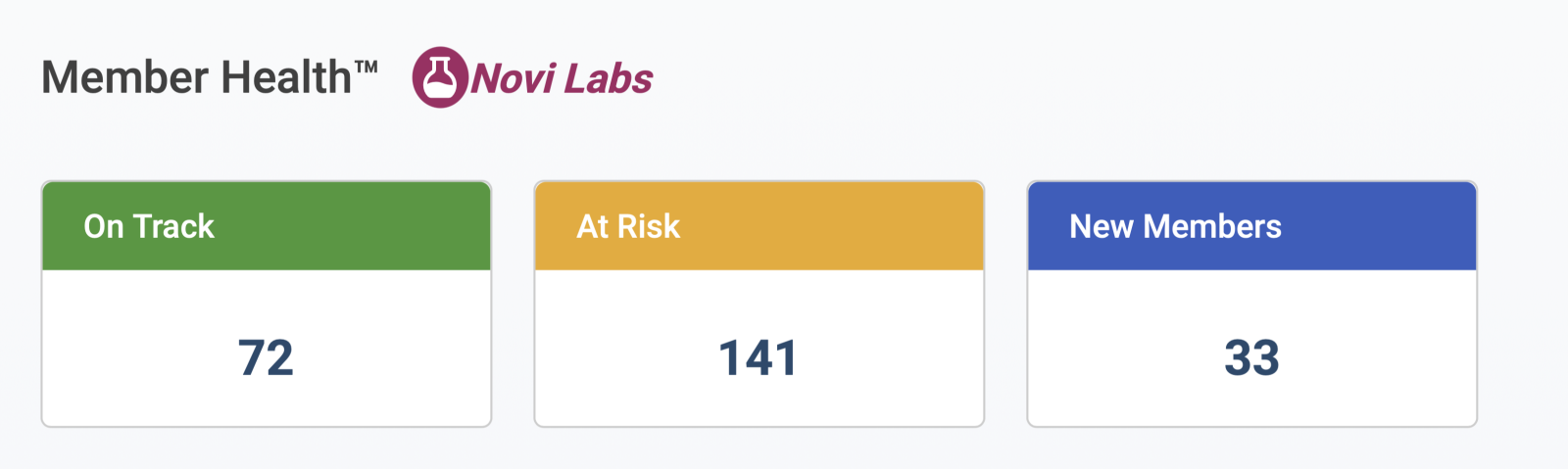
Member Health translates renewal likelihood into a clear status an association team can act on. For all the sophistication underneath it, the system is designed to answer one practical question:
How likely is this particular member to renew?
Rather than handing you a raw probability or an opaque score, Member Health translates its prediction into a clear status your team can act on. Every member falls into one of three groups.
On track. These members are highly likely to renew. The model sees the signals associated with a healthy, committed membership relationship. That does not mean they should be ignored, but it does mean your limited staff time may have a greater impact elsewhere.
At risk. These members are near the tipping point, with roughly a coin-flip chance of not renewing. This is where attention can pay off most. An at-risk flag is not a prediction of failure. It is an early warning delivered while there is still time to change the outcome.
New member. New members do not yet have enough history for Member Health to make an accurate individual prediction, so the system is transparent about that rather than pretending to know more than it does.
Why are new members especially vulnerable?
Even without an individualized prediction, our models consistently identify new members as one of the most vulnerable groups. Novi's analysis found that members who successfully completed their first renewal had 25% higher odds of renewing again. It's a powerful reminder that the first year of membership deserves particular attention.
25%
higher odds of renewing again after their first successful renewal
That makes the first renewal a critical milestone. We treat new members as a distinct priority group—one that deserves deliberate attention before enough history exists for an individualized prediction.
Helping members make it through that first year is one of the highest-leverage things an association can do for retention, and Member Health helps ensure that group never gets overlooked.
What should associations do with renewal predictions?
Associations should use renewal predictions to prioritize human attention, not replace human judgment. When staff time is limited, the prediction helps a team identify where timely outreach is most likely to change an outcome.
In practice, each status points to a different kind of action.
At risk. Start here. These are the members where timely outreach is most likely to change the outcome. A personal call or email from staff or a volunteer leader, a reminder of the value they have received, or an invitation to an upcoming event can turn a coin flip into a renewal. The goal is a conversation, not another automated reminder.
New member. Treat the first year as onboarding, not a waiting period. A welcome call, an early introduction to a committee or member community, and a check-in well before the first renewal notice help new members build the connections that bring them back.
On track. Keep these members engaged without spending scarce staff time on retention outreach they do not need. They are often the best candidates to volunteer, mentor a new member, or share why they belong.
Member Health is designed to focus the judgment and relationship-building skills of experienced association professionals where they can matter most.
The prediction is only the starting point. Retention is won through what happens next: the welcome extended to a new member, the timely outreach to someone at risk, and the human connection that gives someone a reason to stay.
Member Health is Novi AMS's AI-powered membership renewal prediction capability and one pillar of Amplify, Novi's suite of AI capabilities built specifically for associations.
See what Member Health could do for your association.
Ready to take a more proactive approach to member retention? Let's have a conversation about your association's goals and challenges, then explore how Novi and Member Health can help.
Quick answers about membership renewal prediction
▸ What is membership renewal prediction?
Membership renewal prediction uses historical outcomes and member information to estimate whether an individual member is likely to renew. It helps an association distinguish members who appear healthy from those who may benefit from timely attention.
▸ How is Member Health different from an engagement score?
An engagement score adds up activities using manually assigned weights. Member Health learns from actual renewal outcomes and produces a prediction tied to the question an association is trying to answer: How likely is this member to renew?
▸ Does Member Health replace association staff judgment?
No. Member Health helps staff decide where to focus, but people determine what action to take. The prediction creates an earlier opportunity for a welcome, a conversation, or another meaningful intervention; the relationship remains human.
Associations create change. We amplify it.